Building & renovating
Should I inspect a volume builder home during construction?
In short
Many owners do: a volume build moves quickly, trades are often subcontracted, and each stage is covered up soon after it is finished. Independent stage inspections give you your own record of the visible work and items to raise with the builder. They are separate from the mandatory inspections for the building permit and do not replace them.
- Published
- Reviewed by
- VicWide
- Reading time
- 7 min read
A volume builder, sometimes called a project home builder, builds many homes a year from a set of standard designs, often across the growth estates on Melbourne's fringe. The model works because it is efficient: the same plans, the same trades, the same sequence, and a program that keeps each site moving. The question owners ask us is whether that efficiency leaves room for someone independent to look at the work along the way.
Our answer is that many owners do arrange independent inspections of a volume build, and this guide explains why, what the inspections can and cannot do, how site access works, and how to decide which stages matter for you. It builds on our pillar on independent stage inspections for a new build.
Why do owners inspect a volume build?
Three features of the volume model drive the question.
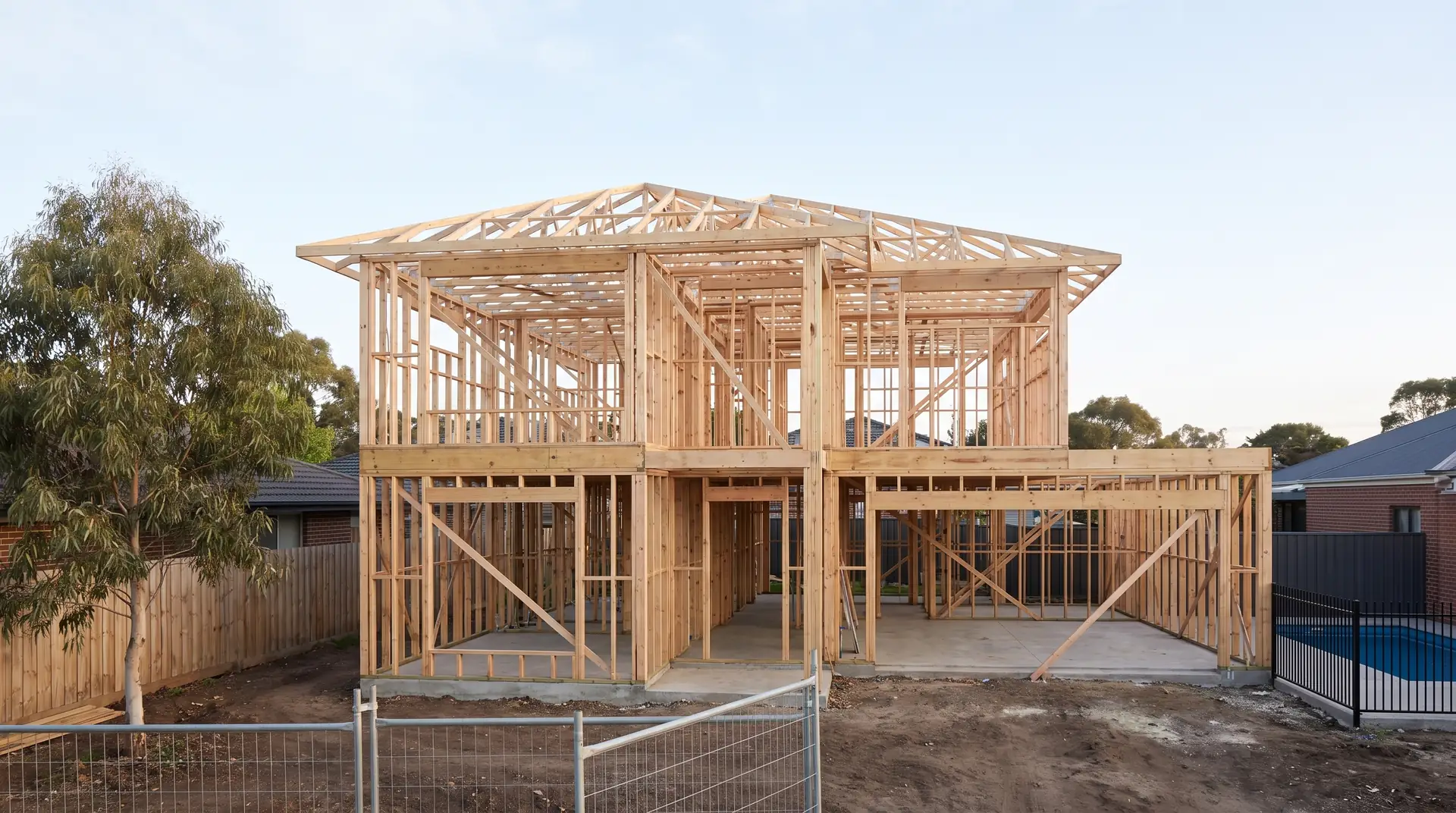
Speed. Stages follow each other closely, and each one is covered up soon after it is finished. The slab is under the frame, the frame is behind the plaster, and the waterproofing is under the tiles within weeks. Once a stage is covered, no one can see it without opening the work up.
Scale. A site supervisor may be managing many homes at once, and the trades are usually subcontracted. The builder's own quality checks exist, but they belong to the builder. An independent inspection is yours.
Distance. Many owners of a volume build live elsewhere while it goes up, or are building an investment they will rarely visit. A written report with photos at each stage is a record you would not otherwise have.
None of this is a criticism of volume building. Plenty of these homes are built well. The point is that you have one chance to see each stage, and an independent inspection makes sure that chance is used.
How is an independent inspection different from the building surveyor's?
A building permit for your home sets out mandatory inspections at certain stages of the work. These are carried out by, or on behalf of, the relevant building surveyor, and they are part of the permit process. They happen whether or not you commission anything.
An independent stage inspection is different. You commission it, for your own information, and it looks at the visible, accessible work at the stage you choose with an eye to the quality of what can be seen. It does not form part of the permit process, it does not replace any mandatory inspection, and it does not change your builder's responsibilities. Keep the two clear in your mind and in your conversations with the builder, so no one expects one to do the other's job.
Which stages are worth it in a volume build?
The stages owners commonly ask us to inspect are slab or base, frame, lock-up, fixing, and completion or handover. Our guide on which stages of a new build are worth an independent inspection weighs each one. In a volume build, a few points are worth adding.
The frame stage is the one owners most often choose if they choose only one, because so much is covered immediately afterwards and because a report at that point can be acted on before the plaster goes up. The slab or base stage is brief and easy to miss, so tell us early if you want it. Lock-up is a natural point to look at the roof, external cladding, windows and the wrap and flashings that keep water out. Fixing shows the plaster, internal doors, cabinetry and waterproofing before the finishes hide them. Completion is the last look before you take the keys; on its own, that check is our new construction and handover inspection.
Which stages you choose is up to you. The list is what owners commonly request, not a required set, and the inspections are visual: work already covered up at a stage cannot be seen.
How does site access work with a volume builder?
This is the practical hurdle. Under most building contracts the site is under the builder's control until handover, and the contract sets out when and how you, or someone acting for you, can enter. Read that clause before you book anything.
In practice the process is usually straightforward:
- Tell the builder early that you intend to arrange independent inspections at particular stages. Many builders have a standard process for this.
- Ask the site supervisor to let you know when each stage is approaching. Programs shift, so build in some flexibility.
- Give the notice your contract requires and confirm the day and time.
- We attend, usually with the supervisor present, and look at the visible work at that stage.
If your contract limits access in a way that makes a stage difficult to see, tell us and we will talk through what can be arranged. For questions about the contract itself, speak with a lawyer.
What does each report give you, and what do you do with it?
For each stage you receive a written report describing what was observed at that time, with photos supporting the key observations, a clear note of what was not visible or accessible, and a plain-language explanation to help you discuss items with your builder.
Share the report with the builder and ask them to respond item by item. Most items are routine and are attended to as the build goes on; others may need a closer look before the next stage covers them. Keep each report with your contract, the plans and the builder's correspondence. If you have not already set up a folder for the build, our property paperwork service can help you structure it so the paperwork is in order by handover.
Keep in mind the limits. Each inspection is visual and covers what is accessible at that stage. A report is not a certificate or an approval, and it does not confirm that the work complies with the permit or the standards that apply to it. The builder remains responsible for the building work, whatever independent inspections you commission.
How do you prepare, and when should you book?
Preparation is light, but timing matters:
- Share your building contract's stage definitions and the builder's program, if you have them.
- Have the plans and specifications for the build available, including any variations.
- Tell us which stages you are interested in and about any specific concerns, such as a sloping block, a retaining wall or a particular room.
- Let us know as early as possible when a stage is approaching. Volume programs can move quickly in either direction.
- Arrange site access through the builder ahead of each inspection.
Send an enquiry with the build address or the estate and lot number, your builder's name, the stages you have in mind and the next stage date as the builder has it. We confirm the scope and provide a quote. We serve Melbourne and surrounds from our office in Werribee; coverage of a particular estate is confirmed per enquiry, so check the service areas page or include the address and we will come back to you. If the home is already at completion, book the handover inspection instead and tell us your expected handover date.
Not sure which stages suit your build? Ask us. Call or WhatsApp 0406 194 163, or send an enquiry and we will come back to you.
Sources and authorities
These public sources set out the requirements this guide refers to. They are the places to confirm what applies to your build; we help you understand and prepare for them.
- Building and Plumbing Commission: what a building surveyor does, from issuing the building permit to inspecting the work at the mandatory stages.
- Building and Plumbing Commission: free dispute resolution for domestic building disputes.
- Consumer Affairs Victoria: checking progress during a build, including independent building consultants and the building surveyor's inspections.
- Consumer Affairs Victoria: building contracts for new homes, renovations and extensions.